A sunflower is the easiest flower to recognize and one of the hardest to paint small. The shape is so familiar that anything slightly off reads as wrong, and the usual result is a yellow blob with a brown dot in the middle of it.
What you will find here
These are grouped by how much of the flower you actually paint, starting with the versions that barely paint one at all. Difficulty, time, and supplies are under each.
What separates a painted sunflower from a sticker
- Petals are uneven. A real bloom has petals of different lengths, some overlapping, some bent back. Twelve identical petals in a perfect ring is what makes it look printed.
- The center is large. On a real sunflower the seed head takes up roughly a third of the flower. Shrink it to a dot and the whole thing turns into a daisy.
- Use two yellows. One flat yellow goes chalky on the nail. A deeper golden yellow at the base of the petals and a lighter one at the tips gives depth without any real blending skill.
- One flower per nail is usually enough. Sunflowers are big. Crowding three onto a single nail shrinks each one past the point where it reads.
- Green is optional. Leaves help on a pale base and vanish on a dark one. Skip them rather than force them in.
Simple sunflowers: dots, tips, and one accent
Nothing in this group needs a steady hand for more than a minute at a time. Most of them paint one flower, not ten.
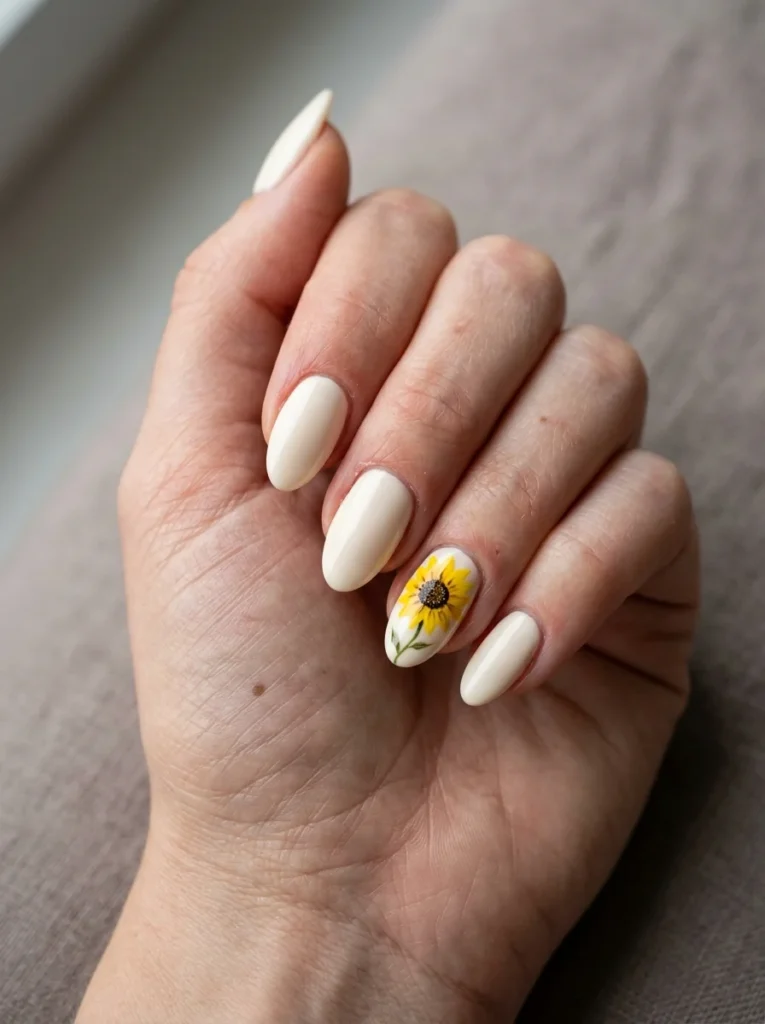
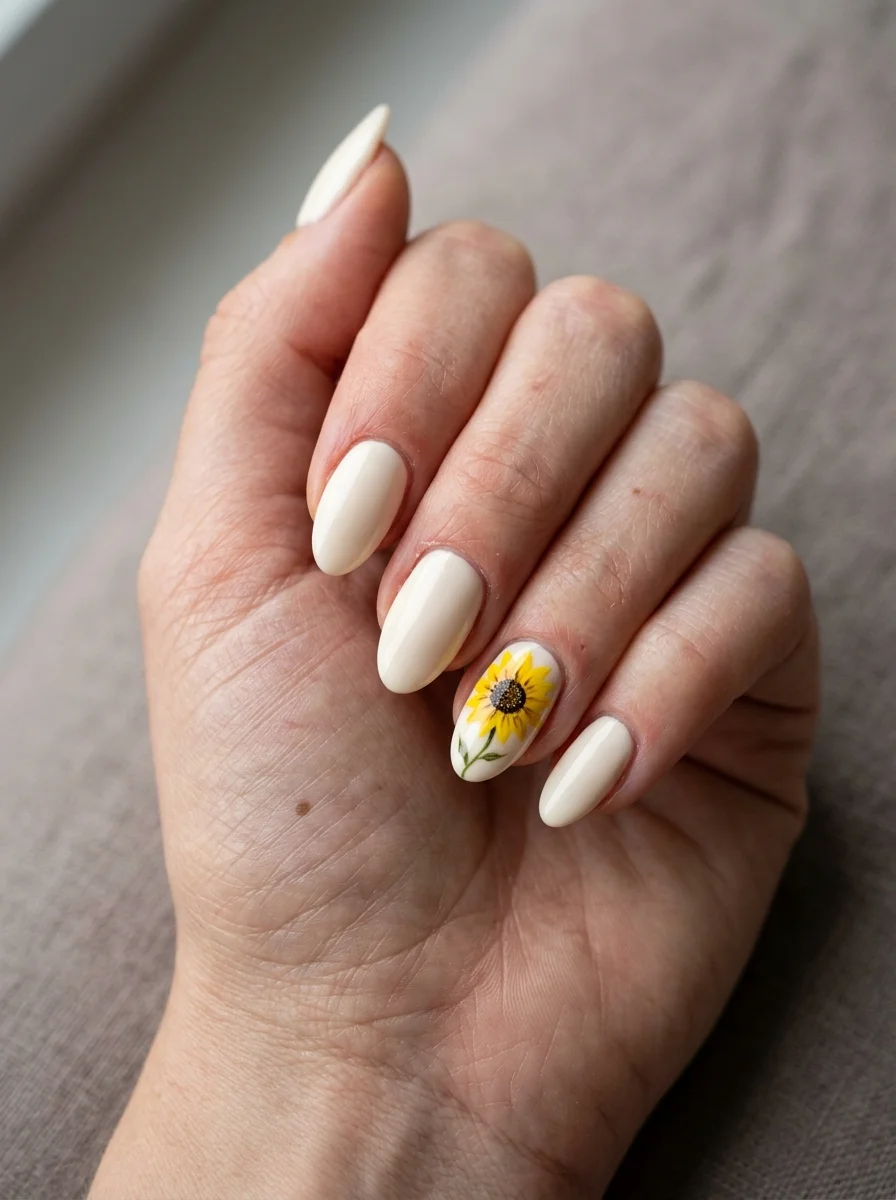
1 Single accent bloom on cream
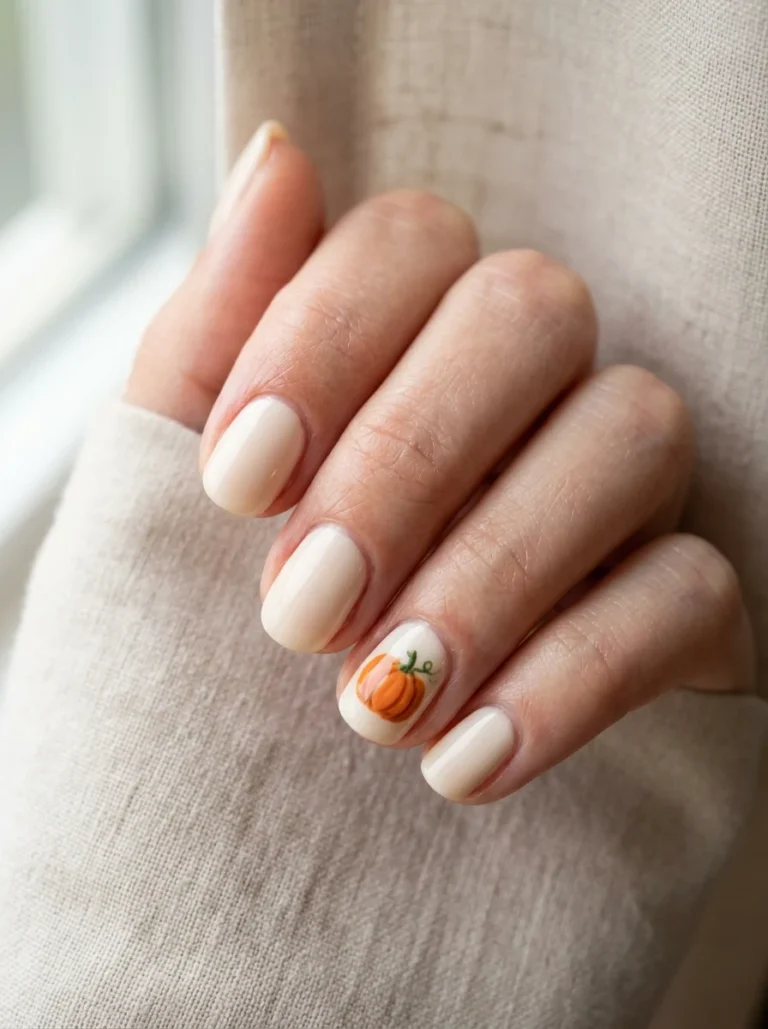
Nine nails in a plain cream and one sunflower on the ring finger. The flower gets a whole nail to itself, so nothing competes with it, and if the bloom comes out lopsided it is one nail rather than the whole set.
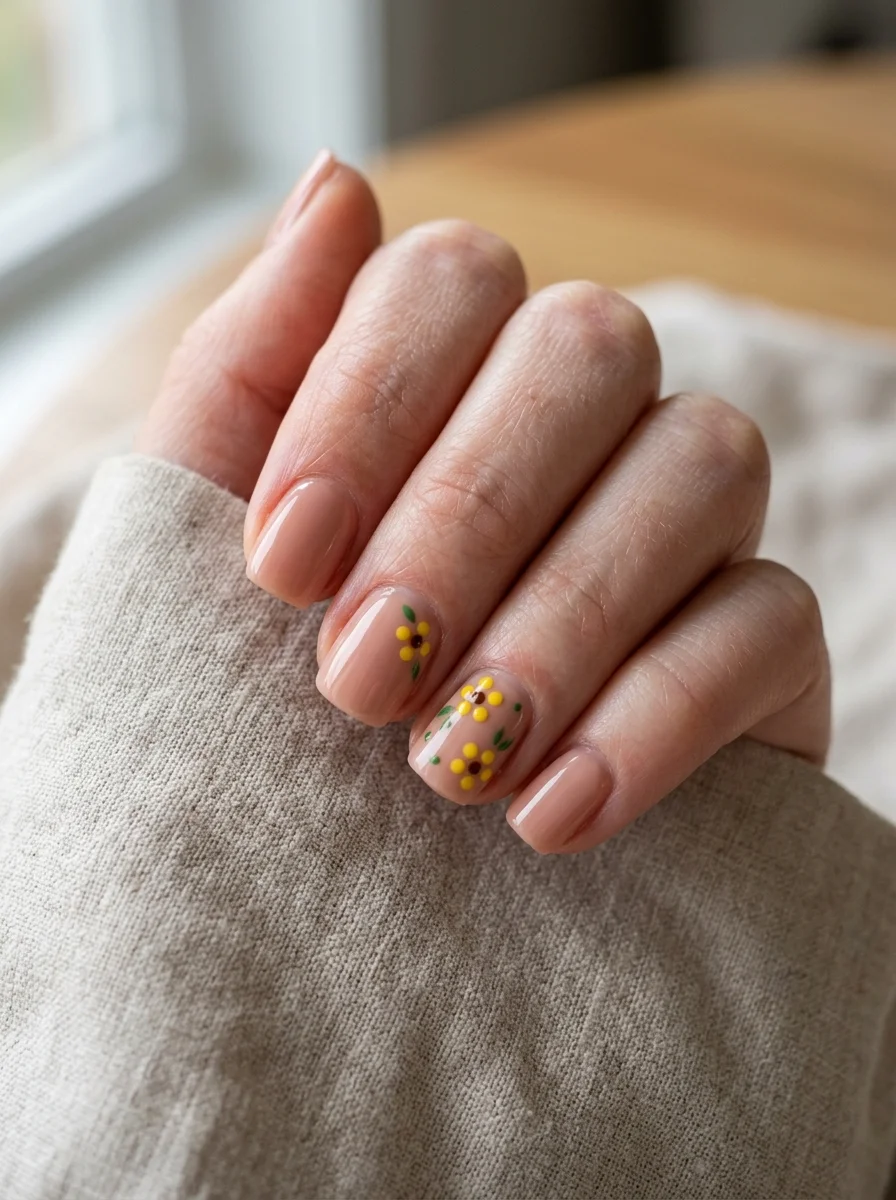
2 Dotting tool sunflower
Six yellow dots ringed around one brown dot, and that is the entire design. No brush work at all. It reads as a sunflower from arm length and as a pleasant abstract shape up close, which is a fair trade for fifteen minutes.
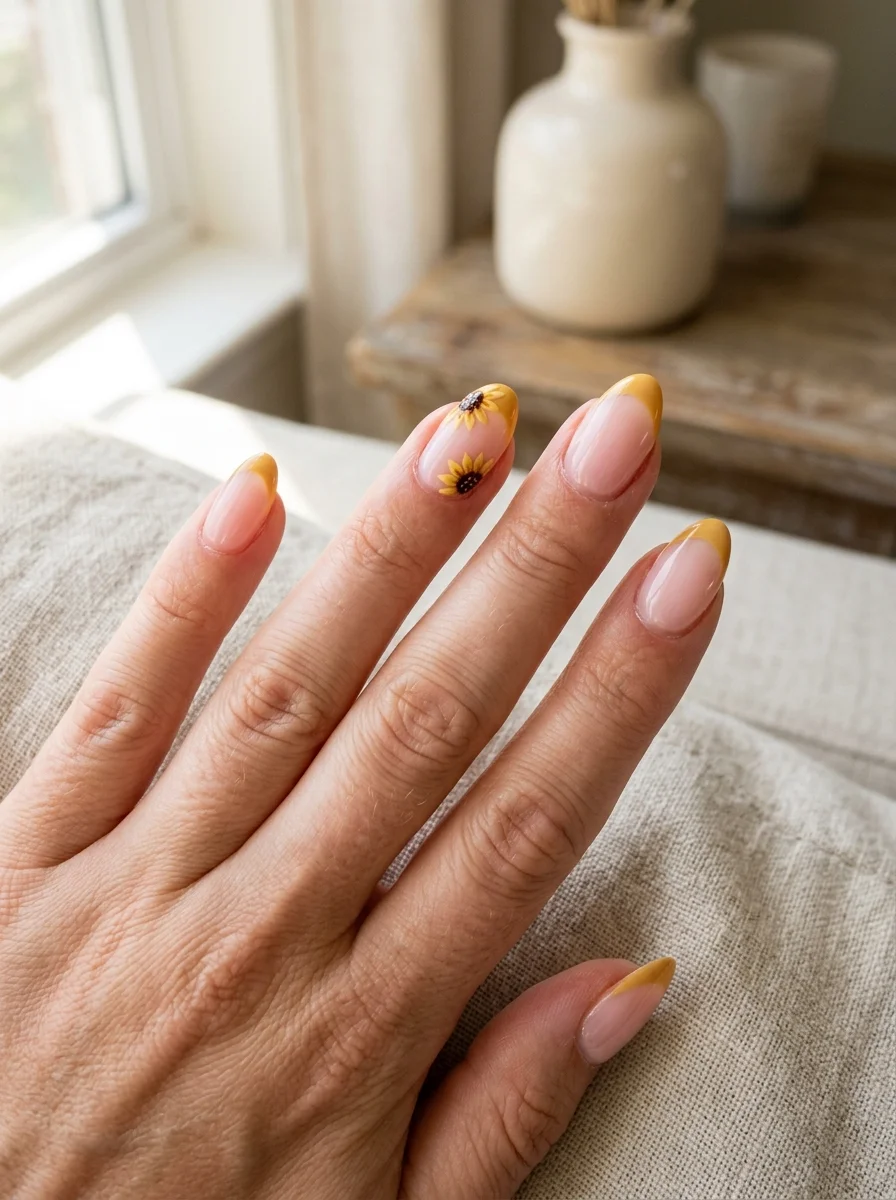
3 Sunflower french tip
A golden yellow tip in place of the usual white, with one small brown-centered bloom sitting on the smile line of two nails. It keeps the manicure structure people already trust and puts the flower where it cannot take over.
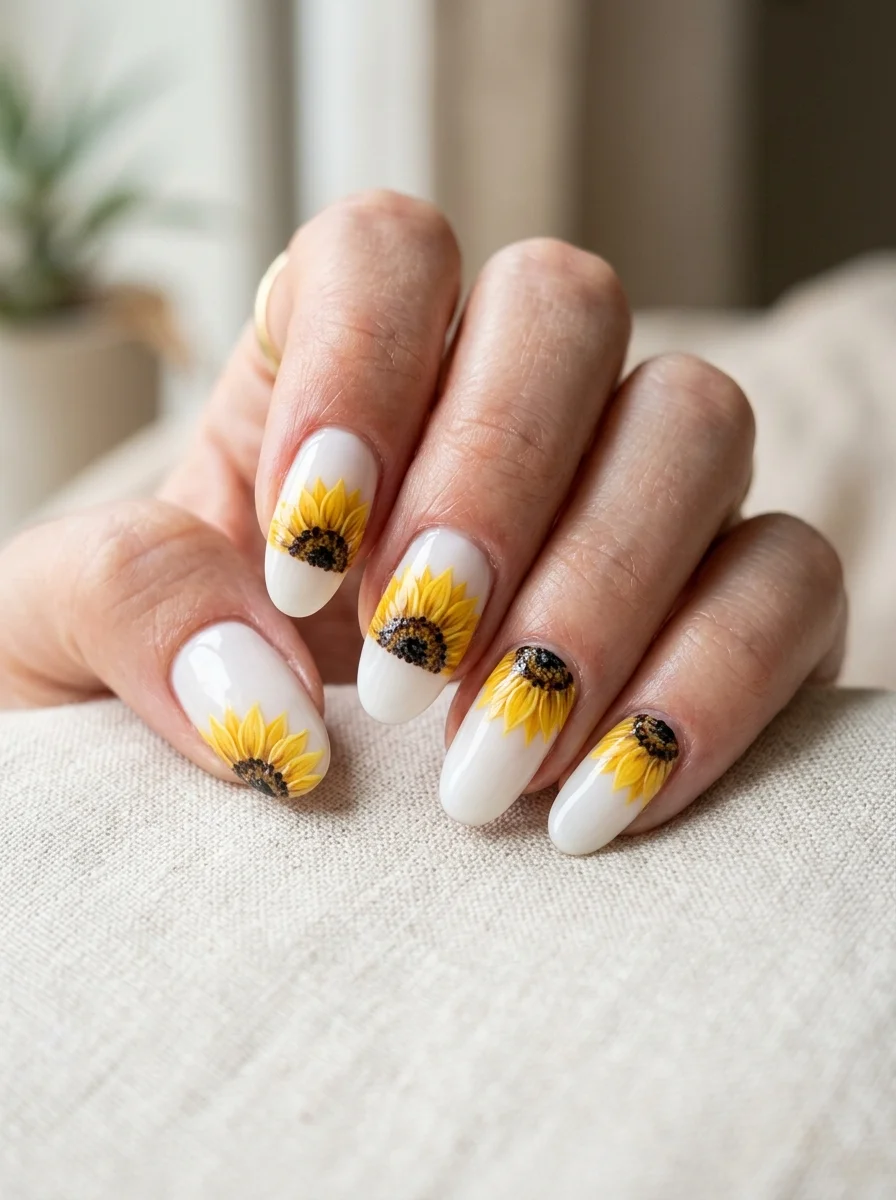
4 Half bloom at the cuticle
The flower grows up out of the cuticle and gets cut off by the base of the nail, so you only paint the top half of it. Fewer petals to place, and the crop is what makes it look deliberate rather than unfinished.
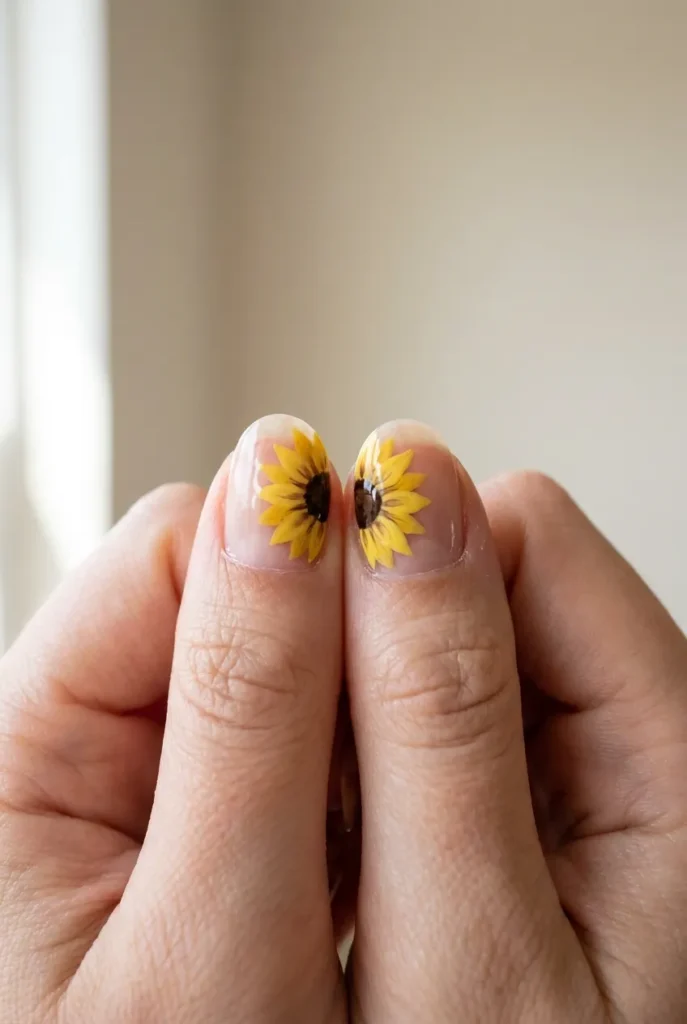
5 Bloom split across two nails
Half the flower on the index and half on the middle finger, so it only completes when the two fingers sit together. It photographs well, which is most of the point, and it gives you twice the surface for the petals.
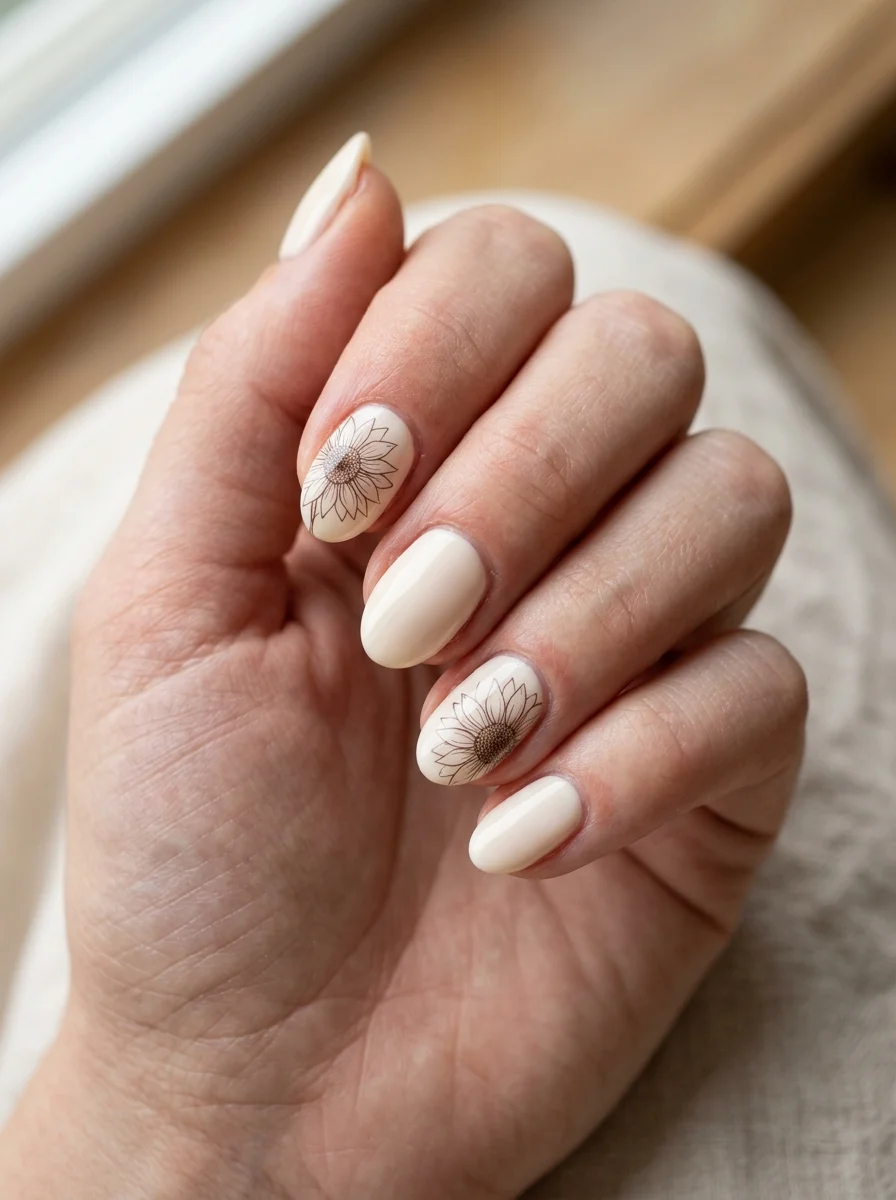
6 Brown line drawing, no yellow
The outline of a sunflower drawn in thin brown lines on a bare cream nail, with nothing filled in. Dropping the yellow entirely is what makes this one wearable somewhere the painted version would not be.
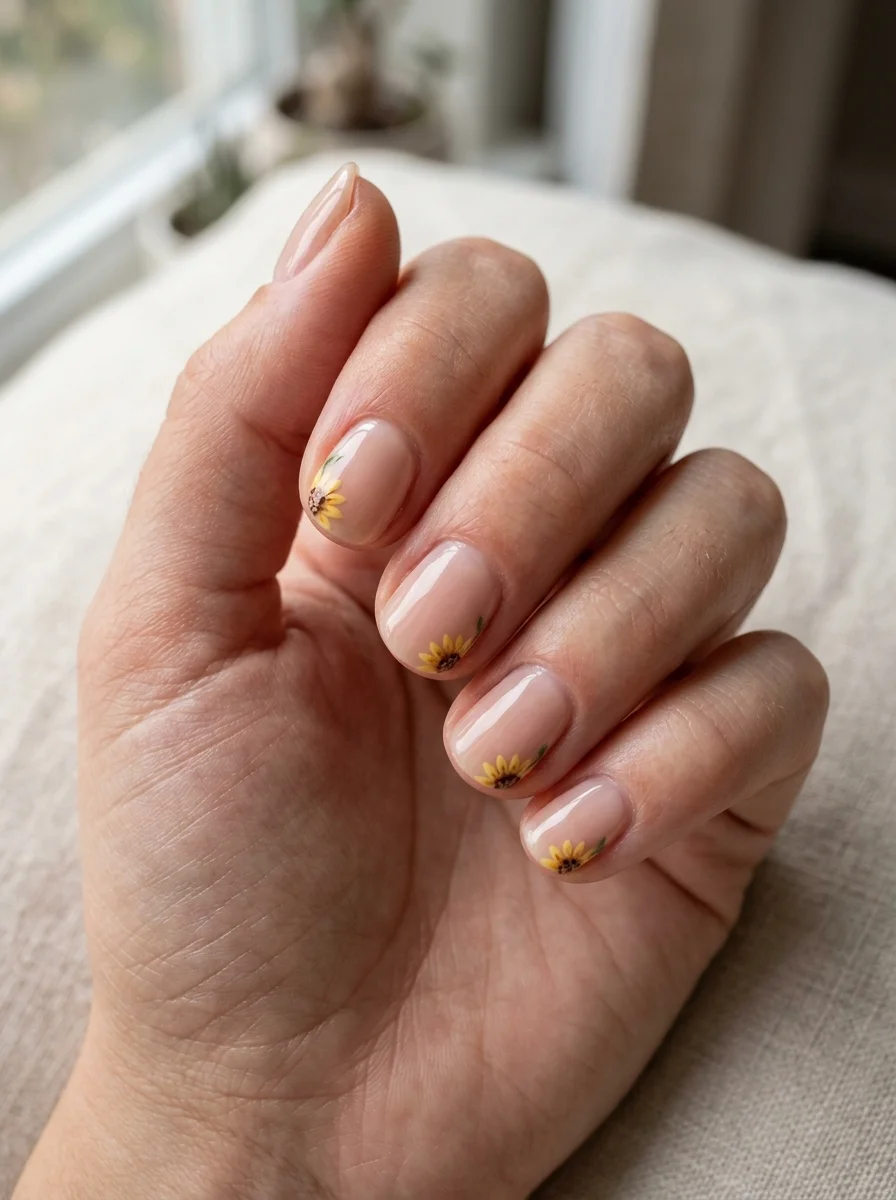
7 Tiny corner sunflowers
One small bloom tucked into the outer bottom corner of every nail. At that size the petals are just short strokes off a center dot, and the repetition across all ten nails does the work instead of the detail.
Sunflowers with something behind them
Same flower, different base. The background is what moves a sunflower manicure from summer to fall, and it changes the design more than the bloom itself does.
8 Sunflower on denim blue
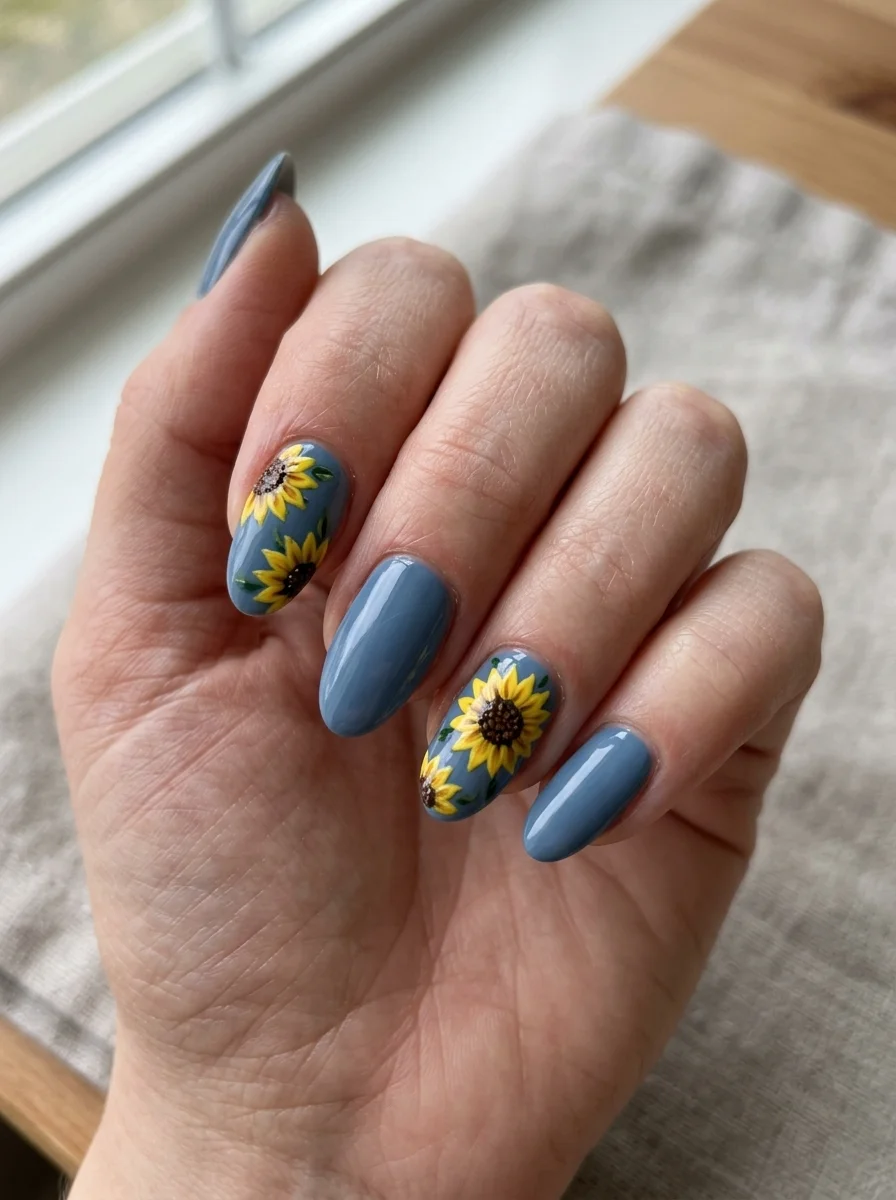
A muted dusty blue base with yellow blooms over it. Blue sits opposite yellow on the color wheel, which is why this pairing looks louder than any other version here and why one or two accent nails is usually the right dose.
9 Sunflower on black
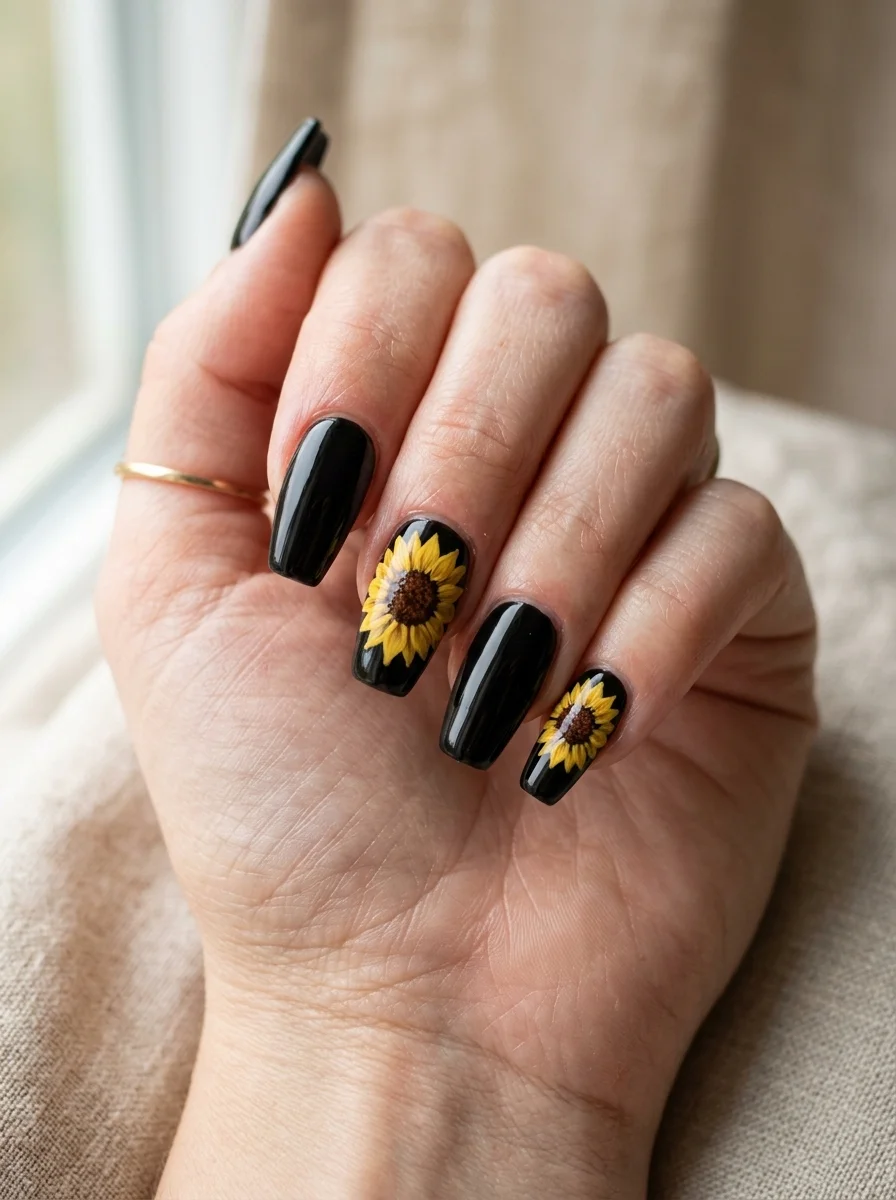
Black base, yellow bloom, no leaves. This is the version that carries furthest into fall, because the black pulls the yellow away from summer entirely. Skip the green here, it turns muddy against black.
10 White base with green leaves
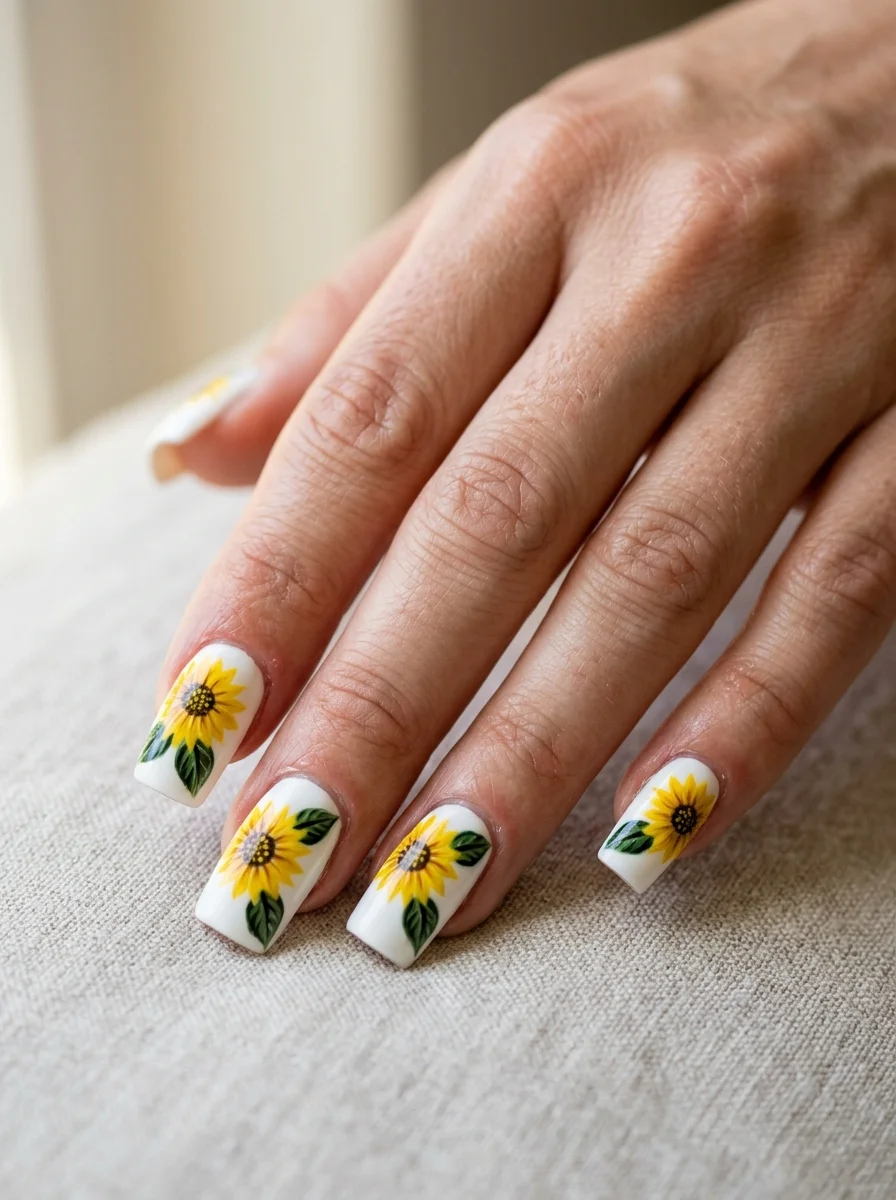
The full storybook version: opaque white nail, a bloom in the middle, two pointed green leaves off the stem. The white is what lets the leaves register at all, and this is the only group where they earn their place.
11 Sunflower field
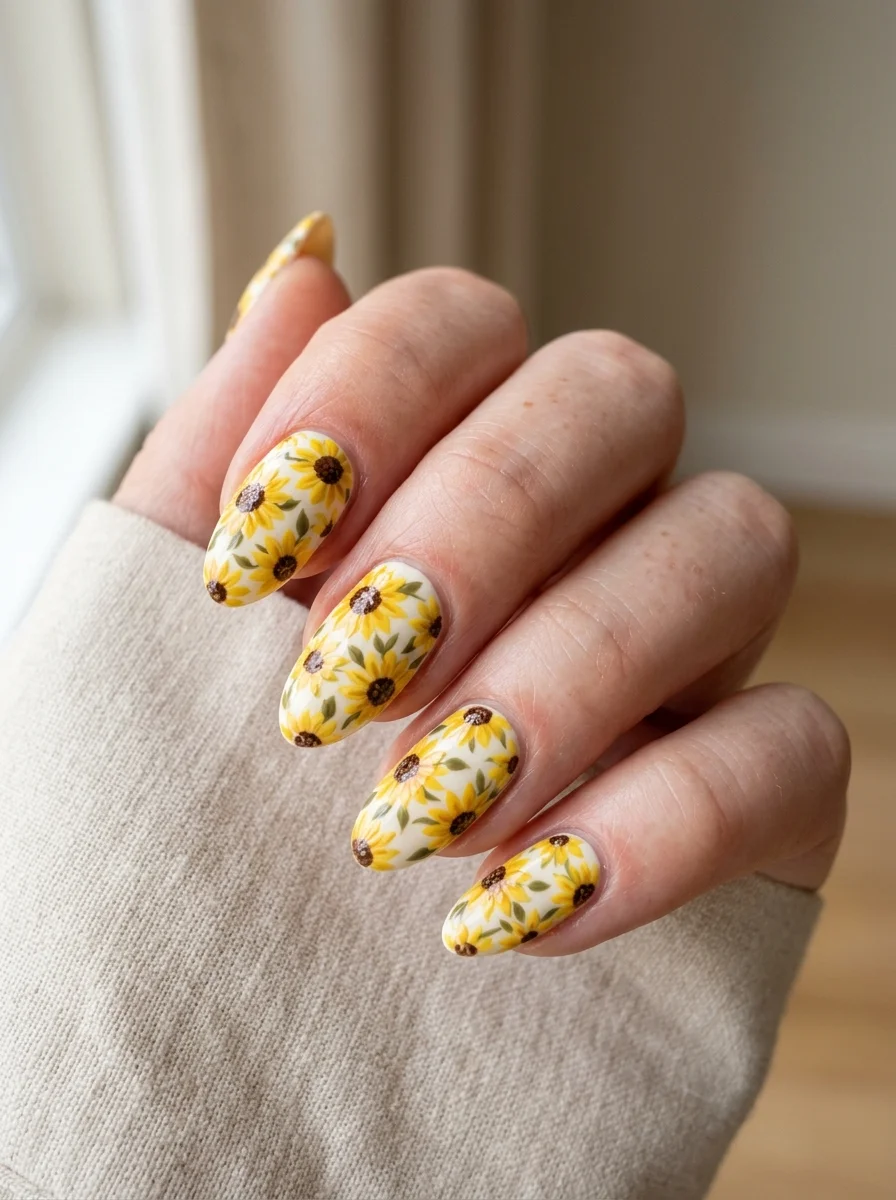
Small blooms repeated across the whole nail with no single focal flower, some cropped by the edges. Crowding is the whole idea here, so the petals can be loose and the sizes uneven without hurting it.
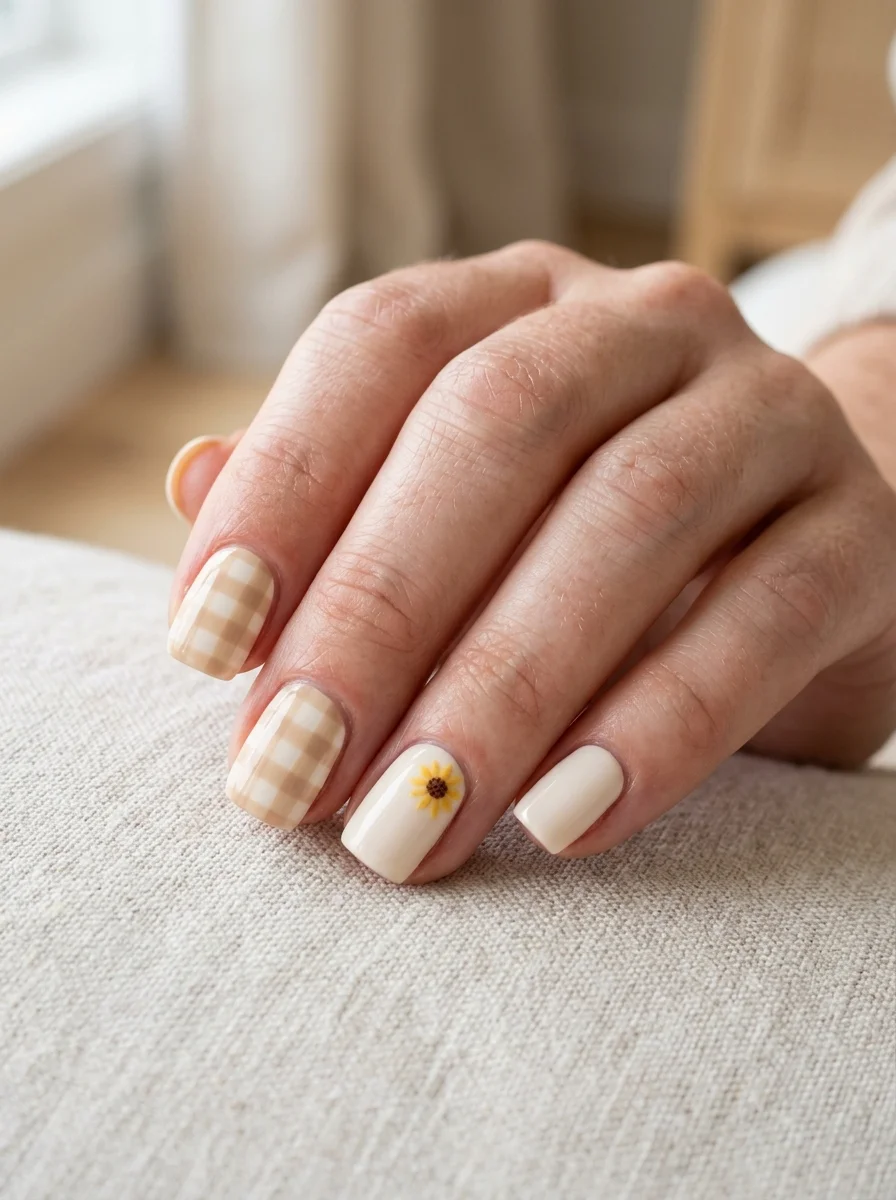
12 Bloom over gingham
A soft checked base in cream and tan on most nails, with one plain nail carrying the flower. Keeping the check and the bloom on separate nails is what stops the design from becoming visual noise.
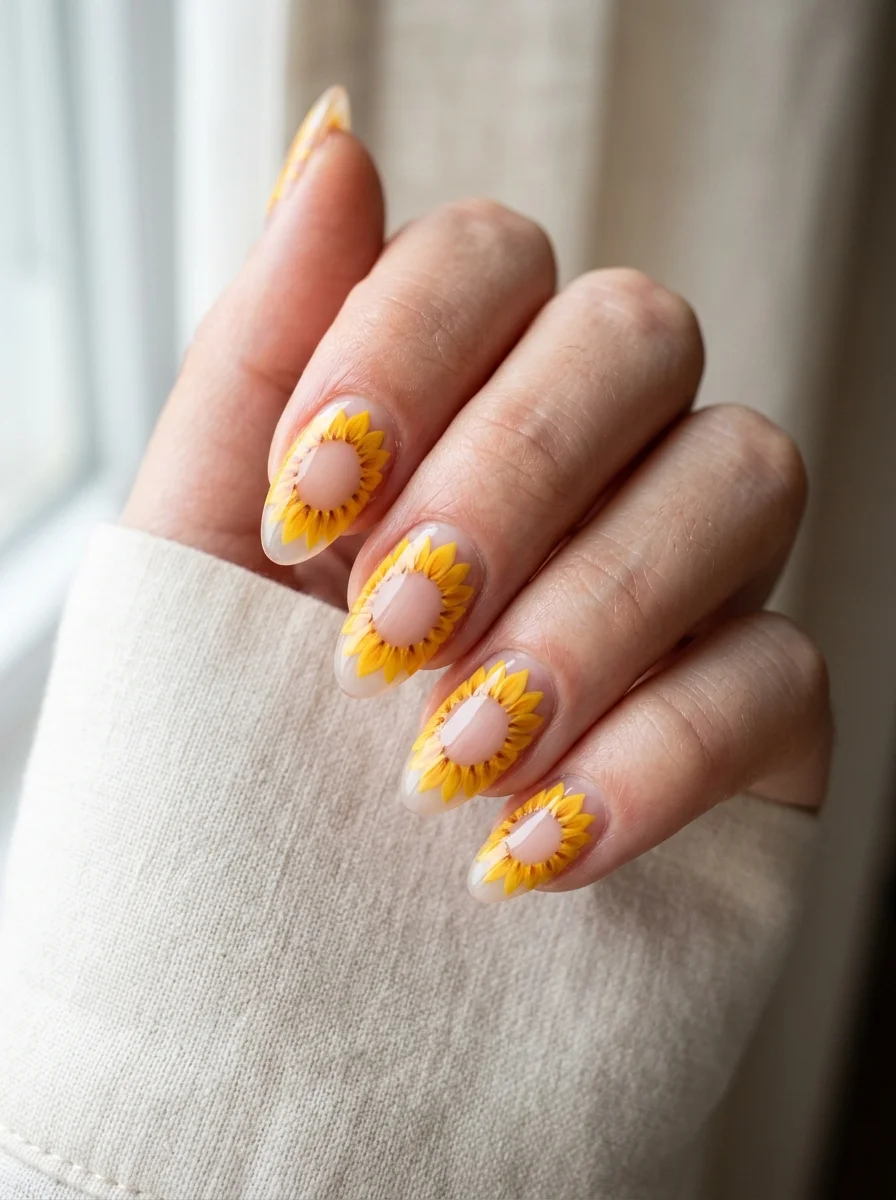
13 Negative space petals
Petals painted in yellow with the seed head left as bare nail rather than filled in brown. It is a smaller amount of paint than it looks, and the empty center is what keeps it from reading as childish.
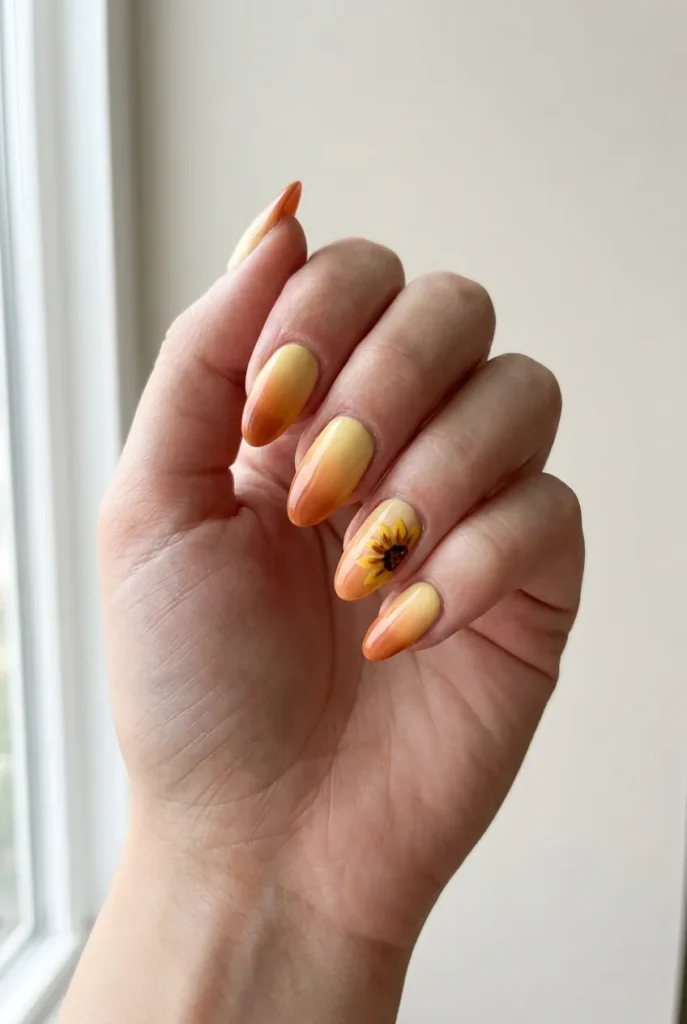
14 Sunset ombre with a bloom
A soft fade from pale yellow at the cuticle to burnt orange at the tip, with one flower sitting where the two colors meet. The gradient does most of the work, so the bloom can be simpler than usual.
Sunflower sets that go further
These need more than polish and a brush, and most of them take an hour. They also hold up longer as a look, because the flower stops being the only thing happening on the nail.
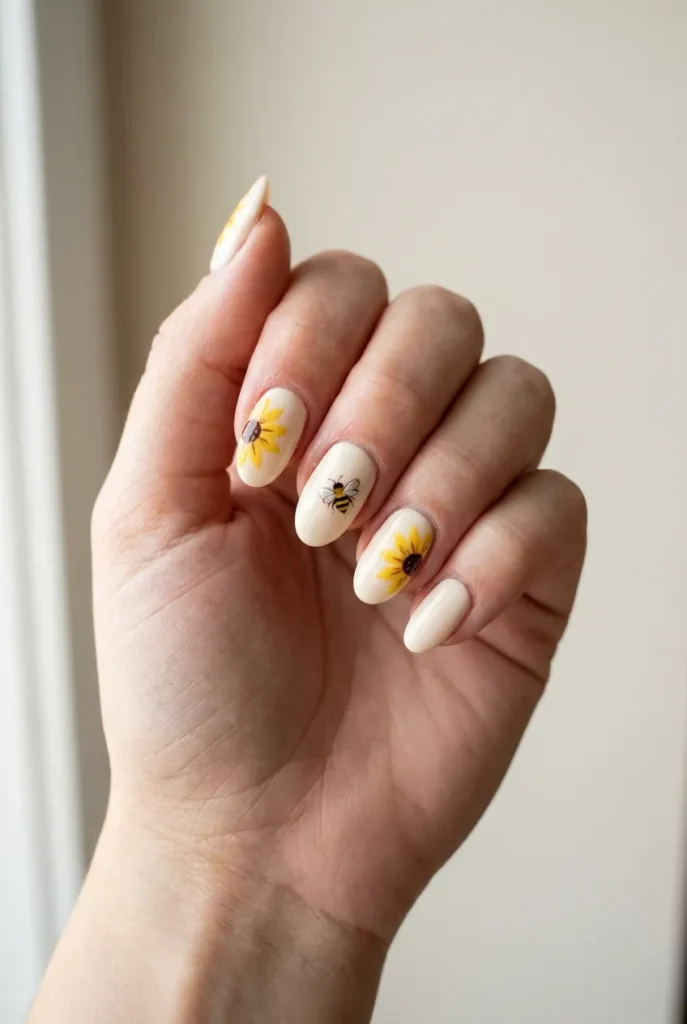
15 Sunflower and bee
Blooms on three nails and one small bee on a fourth, drawn as a striped oval with two clear wings. Keep the bee under about five millimeters, because a large one immediately reads as a cartoon.
16 Gold flake center
Painted petals with loose gold flakes pressed into the wet center instead of a flat brown circle. The texture reads as seed head from a distance and catches light in a way solid polish cannot.
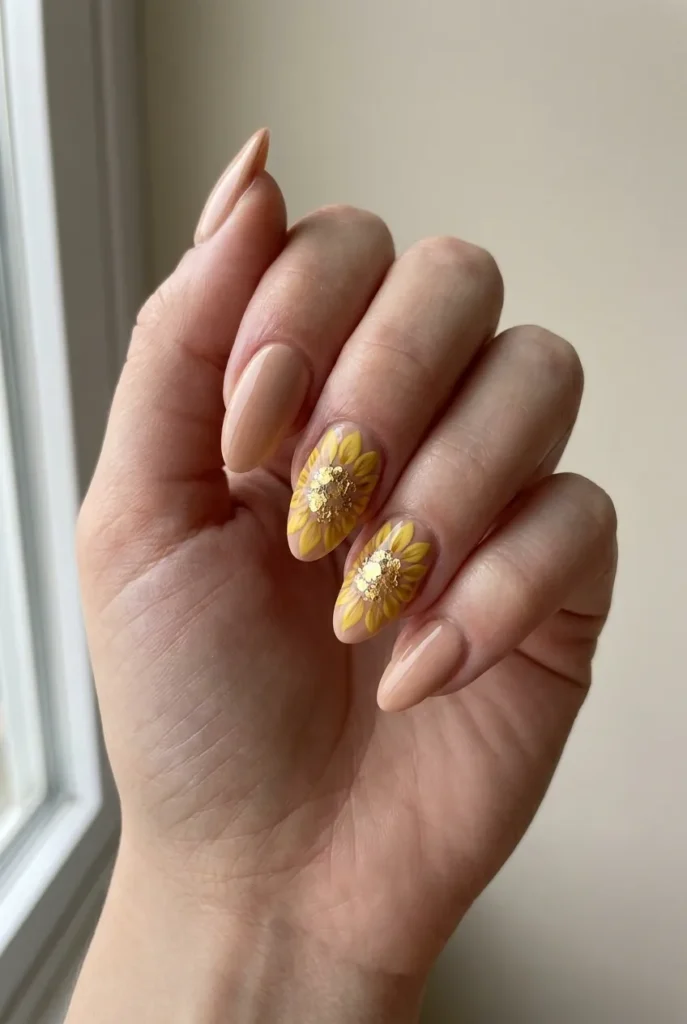
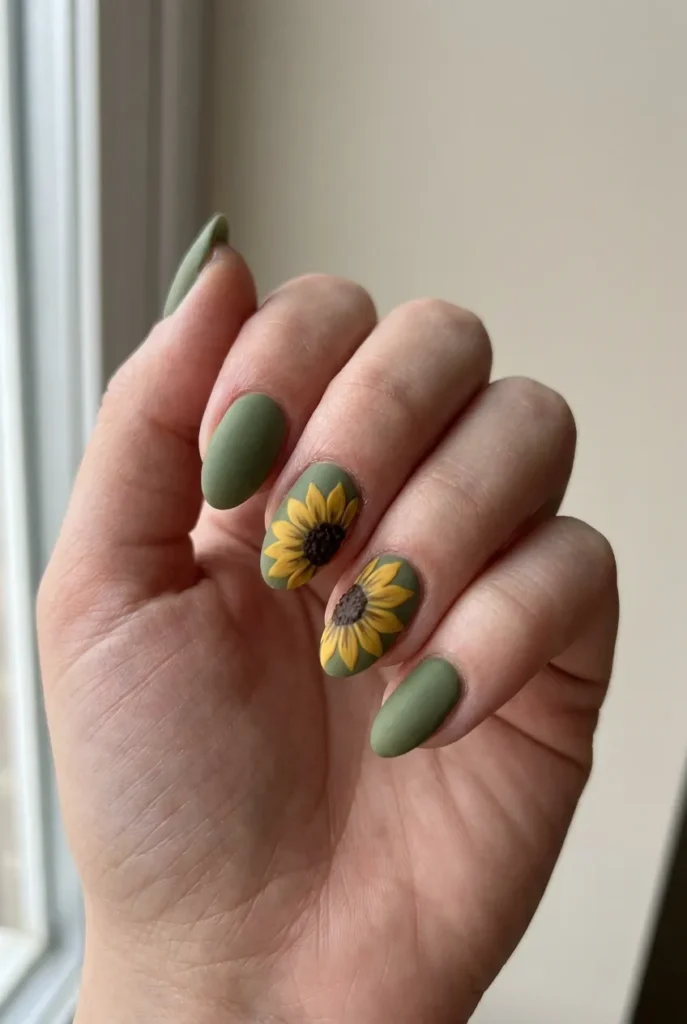
17 Matte bloom on olive
An olive green base with a mustard-toned flower, all of it under a matte topcoat. Dropping the yellow toward mustard and killing the shine is the single easiest way to move a sunflower into October.
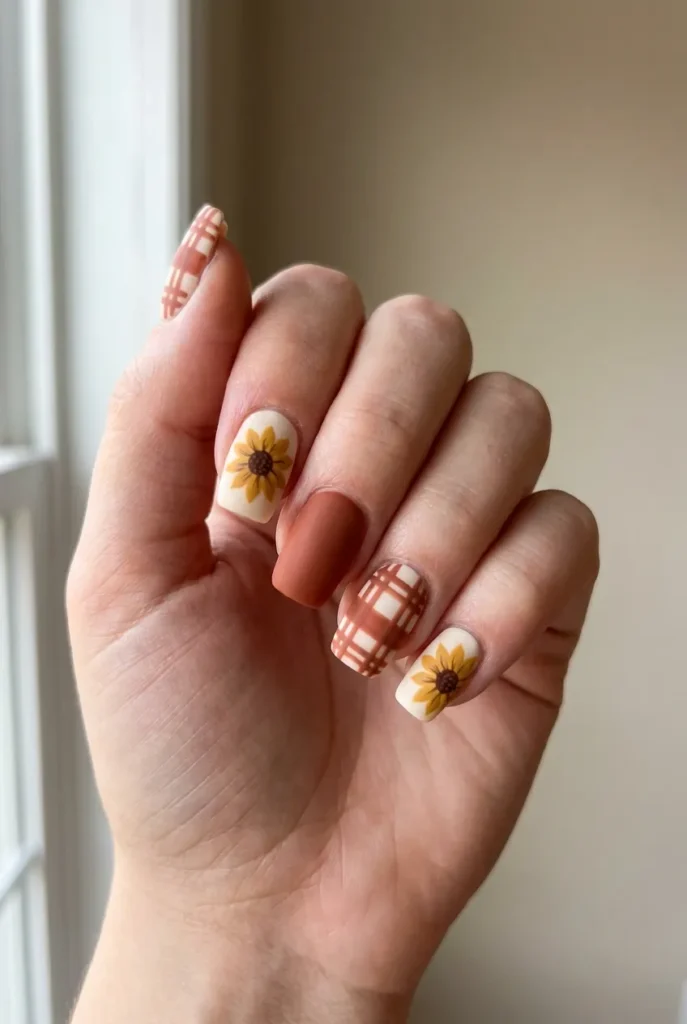
18 Sunflower and plaid
Alternating nails, plaid in rust and cream on two, a bloom on the others. The plaid is what makes the yellow read as fall rather than August, and neither pattern shares a nail with the other.
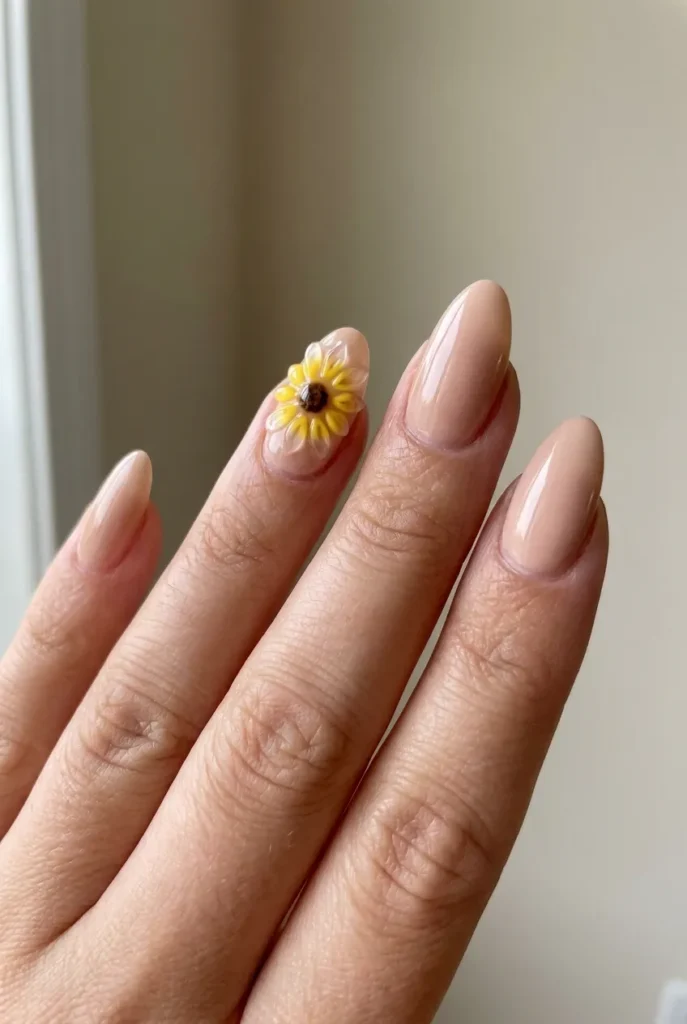
19 Raised petals in builder gel
Each petal built up in clear gel over the painted flower so it sits above the nail surface and casts a small shadow. This is salon-level work and needs a lamp, but it is the only version here with real dimension to it.
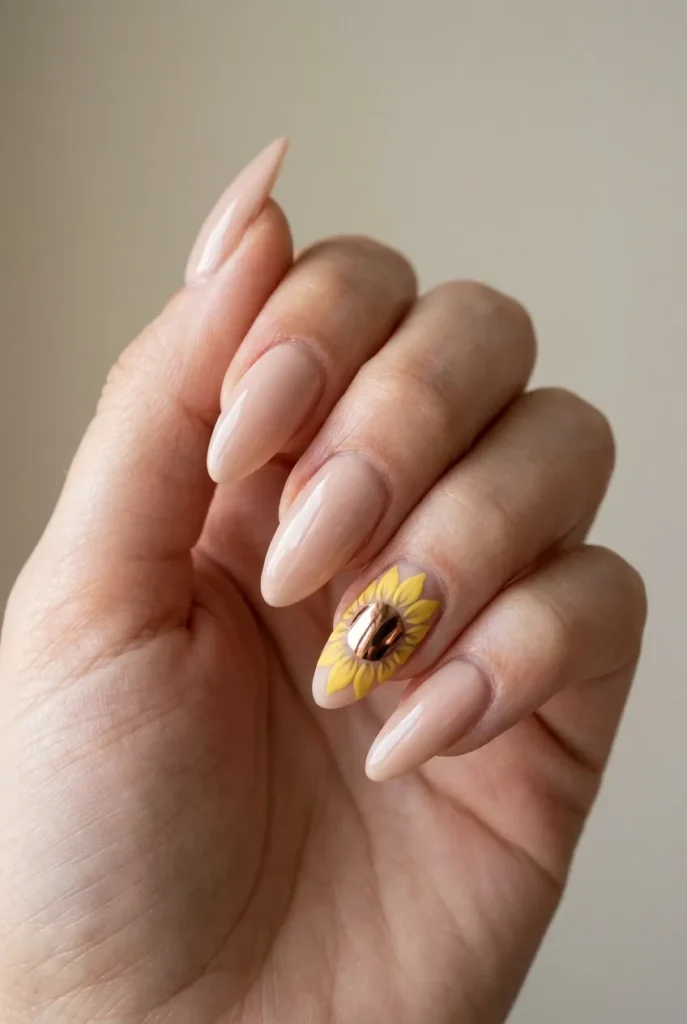
20 Chrome seed head
Matte yellow petals with a bronze chrome center rubbed in over a gel base. The contrast between the flat petals and the mirrored middle is the whole design, and it works better on longer nails where the center has room to sit.
How to paint a sunflower, step by step
Most people start with the petals and run out of room for the center. Working the other way around fixes almost every problem before it happens.
- Paint the center first. A brown circle roughly a third of the width of the nail, placed slightly off-center so the flower does not look posed. Let it dry fully before anything touches it.
- Place four petals at the compass points. Top, bottom, left, right. These four anchor the spacing, and getting them evenly placed is the only part that really needs care.
- Fill the gaps. One or two petals between each of the first four. You are aiming for something like twelve to sixteen total, but nobody is counting them on a fingernail.
- Pull each stroke inward. Start at the outer tip of the petal and drag toward the center. The brush naturally thins as you lift, which gives you a pointed outer edge and a wider base, which is the shape a real petal has.
- Make two or three petals shorter. Uneven lengths are what stop it reading as a printed graphic. Overlap one petal slightly over its neighbor while you are at it.
- Add the second yellow. A short stroke of deeper gold at the base of each petal where it meets the center. This takes about a minute and does more for the finished look than any other single step.
- Dot the seed head. Three or four tiny black or dark brown dots in the center, not a full grid. Enough to suggest texture, not enough to look like a pattern.
- Float the topcoat. Load the brush heavily and lay it across the nail without pressing. Dragging a normal topcoat over dry nail art is the most common way to smear a flower you just spent twenty minutes on.
Practice the petal stroke on a piece of paper or a nail wheel before going near your hand. Ten strokes is usually enough to find the angle, and it costs less than removing a failed flower and starting over.
Common questions
Are sunflower nails a summer or a fall design?
Both, and the base color decides which. A bright yellow bloom on white or blue reads as summer. The same flower in mustard on olive, black, or rust reads as fall. Sunflowers bloom across most of the US from midsummer into September, so late August through October is the most natural stretch to wear them.
Do sunflower nails work on short nails?
One flower per nail, yes. A field of them, no. On short nails the bloom needs to sit alone with no leaves and no stem, or there is not enough surface for any of it to register. The dotting tool version and the corner sunflowers are the two that hold up best on very short nails.
Why does my yellow polish look streaky?
Yellow pigment is thin by nature and almost never covers in one coat. Paint it over an opaque white base rather than building three coats of yellow, which stays streaky and takes far longer to dry. This applies to the petals as much as to a full yellow nail.
What colors pair well with sunflower nails?
Cream and warm nude are the safest and let the flower carry the design on its own. Denim blue is the loudest. Black is the most seasonal. Olive and sage sit somewhere in between and are the easiest way to make the yellow look intentional rather than left over from July.
How late in the year can I wear them?
Through the middle of October if the base is dark or muted. Past that the yellow starts to fight everything else people are wearing, and the October designs in deeper shades take over. A mustard bloom on olive is the version that stretches furthest.
What is the fastest one here?
The dotting tool sunflower, at about fifteen minutes for two accent nails. No brush control needed and no way to ruin it. If that still feels like too much, a plain seasonal shade from the short fall nails set takes ten.
Do decals work instead of painting?
They do, and they are the reason so many sunflower manicures look flat. A decal has perfectly even petals and a hard printed edge, which is exactly the thing that makes the flower read as a sticker. If you use one, cover it with a thick topcoat and add a couple of hand-painted petals over the edge to break the outline.